

How will transformative AI reshape the world of work? In this essay, David Autor and Neil Thompson1 set out their new “expertise framework” to answer this question. TAI will not simply eliminate jobs; it will reshape the value of human expertise. The future is highly uncertain, and it is very difficult to know which occupations will thrive or struggle. Yet this new framework, they argue, can help us think through very different scenarios for the future of work, from gradual automation to complete human labor obsolescence—and how we can prepare for them.
I. The Puzzle of Divergent Fates
Consider two occupations that looked remarkably similar 40 years ago, both seemingly destined for obsolescence in the computer era. Accounting clerks spent their days recording transactions, reconciling statements, and compiling financial reports. Inventory clerks examined stock, maintained records, and computed prices. Both performed many job tasks that economists classify as “routine”: tasks that follow explicit rules and procedures, exactly the kind that can be codified in software and executed by computers.
Fast forward to the present, and the trajectories of these occupations have diverged. Accounting clerks saw their wages rise by 39%, while employment fell by 32%. This occupation became more selective, more specialized, and better paid. Inventory clerks experienced the opposite: Wages fell 13%, while employment expanded by 175%. The occupation became more accessible but less lucrative. These occupations faced the same technological force but experienced opposite outcomes.
This pattern defies standard automation narratives. The conventional wisdom is that as tasks are automated, workers in more automated occupations are pushed downward into lower-paid, less expertise-intensive jobs. The reality, as these two occupations illustrate, is more nuanced. Understanding why the same type of automation—computerization of routine tasks—has countervailing impacts on employment and wages across and within these two occupations is critical to understanding the technological era that has just ended and to anticipating the consequences of the artificial intelligence era that we have recently entered.
Current policy debates focus largely on which jobs AI will eliminate. The accounting versus inventory clerk example reveals a subtler reality: Automation’s impacts on both employment and wages depend not only on how many tasks are automated, but which. When automation removes an occupation’s simpler tasks, the work that remains is more complex, requiring workers to focus more on high expertise tasks. This winnows out less expert workers, but also raises the value of the expertise remaining, thus boosting wages. Conversely, when automation removes an occupation’s most complex tasks, the remaining work becomes less expert and thus more accessible to a greater number of workers. So even though the automation of expert tasks is productivity-enhancing, the influx of newly qualified workers tends to reduce wages, rather than boost them. This distinction between automating an occupation’s expert versus inexpert tasks illuminates the transition we’re entering. It explains why some workers benefit from automation while others are harmed, why wages and employment can move in opposite directions, and why the same technology can simultaneously increase inequality by raising barriers to elite occupations while democratizing access to previously exclusive fields.
“While we cannot predict exactly which occupations will thrive or struggle, we can identify a central mechanism that will contribute to their fate.”
These contrasting patterns of expertise automation should shape how we think about the AI transition underway. While we cannot predict exactly which occupations will thrive or struggle, we can identify a central mechanism that will contribute to their fate. Understanding this mechanism—the changing value of human expertise across activities and occupations—is crucial for crafting effective policy responses. Without it, we might attempt to preemptively retrain workers who are “exposed” to AI, even if their wages are likely to rise because of it. Or we might erroneously anticipate that all AI-exposed occupations are likely to shrink, when in fact some will become more plentiful as less expertise is needed to do them.
The stakes for accurately understanding these economic mechanisms and design policies appropriately are enormous: Humanity’s management of transformative AI has the potential to exacerbate inequality by diluting the economic value of the expertise of the many while amplifying the value of the expertise held by a few. This technology might also be used to democratize opportunity by lowering barriers to previously exclusive occupations, enabling a larger set of workers with appropriate training and AI-enhanced tools to perform valuable work in health care, law, software development, design, contracting, and the skilled trades. While it’s likely that some of both will occur, choices that we make today about developing and deploying these technologies will shape the contours of labor markets and societies globally.
“We believe that an end to labor scarcity would pose three surpassing challenges: social organization, income distribution, and democratic stability.”
This paper begins by sketching the expertise framework proposed in our 2025 paper “Expertise,”2 and then applies this framework to consider two broad scenarios by which AI may reshape labor markets. The first is a “we fail to imagine the future of expertise” scenario. Here, the central societal challenge is managing the transition from old work to new work amid rapidly shifting expertise requirements and associated wage changes. The second scenario is a future where human expertise is stripped of economic value, displaced by more capable and cost-effective machines. Here, the central challenge is maintaining democratic stability absent a labor market that distributes income broadly by imbuing most adults with significant earnings potential. Under either scenario, AI does not eliminate scarcity, contrary to what some futurists anticipate. It could nevertheless usher in the end of labor scarcity, producing what Nobel-prize winner Herbert Simon called “intolerable abundance.”3 While Simon meant this phrase ironically, we believe that an end to labor scarcity would pose three surpassing challenges: social organization, income distribution, and democratic stability. We conclude the essay by proposing mechanisms by which affluent countries (though unfortunately not all countries) can hedge against the potential devaluing of human expertise. These hedges could prove socially and economically valuable regardless of which scenario comes to pass.
II. The Expertise Framework
Every job is a bundle of tasks. A radiologist doesn’t just read X-rays—he consults with patients, coordinates with other physicians, manages staff, documents findings, and stays current with medical research. A plumber doesn’t just fix pipes—she diagnoses problems, estimates costs, orders supplies, schedules appointments, and explains issues to customers. Some of these tasks require deep, specialized expertise acquired through years of training. Others are relatively inexpert, requiring skills that most workers already possess.
This distinction between expert and inexpert tasks within occupations drives an underappreciated dynamic. When an occupation’s less expert tasks are automated, as in the case of accounting clerks, it generally becomes more specialized in its expert tasks. For example, accounting software eliminated tasks related to filing and basic arithmetic but left complex reconciliation and problem-solving for workers. Now accounting clerks spend more time on expert tasks, creating a higher barrier to entry. Fewer workers now may qualify for the job, but those who do command higher wages.
By contrast, technologies that relax expertise requirements allow more workers to enter. Inventory clerks also underwent considerable automation, with inventory management systems and handheld scanners automating the complex tracking and pricing calculations that once required significant training, leaving mainly physical tasks like counting and stocking. More workers can now qualify for inventory clerk positions, expanding potential labor supply. The influx of workers raises employment, providing them new opportunities, but also puts downward pressure on the wages of incumbent workers.
Automation doesn’t always proceed in the same direction over time, even for the same occupation. Inventory management systems were pioneered by e-commerce giants like Amazon.com, which grew to become the second largest private sector employer in the United States. These systems eliminated many of the cognitive, relatively expert elements of the job: As one undercover Amazon worker put it in 2013, “we are machines, we are robots.…we don’t think for ourselves.”4 But now, as Amazon leads a highly publicized effort to replace more than half a million warehouse jobs with robots in the coming decades, these same jobs stand to become more expert. As a 2025 New York Times article observed, “The company transformed the U.S. work force as it created a booming demand for warehousing and delivery jobs. But now, as it leads the way for automation, those roles could become more technical, higher paid and more scarce.”5 The expertise framework can shed light on how automation can first cause an occupation to experience wage loss, and then a subsequent wage gain, depending on what part of the job gets automated first.
“The expertise framework can shed light on how automation can first cause an occupation to experience wage loss, and then a subsequent wage gain, depending on what part of the job gets automated first.”
This mechanism differs substantially from standard automation narratives. The conventional view focuses on labor demand: Automation replaces workers, reducing demand for their labor, causing both wages and employment to fall together.6 The expertise framework reveals that automation also shifts labor supply constraints. By changing which workers are qualified to perform an occupation’s remaining tasks, automation creates divergent wage and employment effects.
This difference matters. Under the demand-side view, automation is primarily about job displacement—a race between man and machine, as in the memorable title of Acemoglu and Restrepo’s 2018 paper.7 Under the expertise framework, automation redistributes opportunity. Some occupations become more exclusive and rewarding, others more accessible but less lucrative. Neither outcome is inherently good nor bad—it depends on your starting point and society’s goals.
Critically, the same task can be expert in one occupation and inexpert in another. Proofreading is an inexpert task for professors but an expert task for editorial assistants. Basic coding might be inexpert for senior software engineers but represents specialized expertise for junior developers. This relativity means automation of the same task can simultaneously harm some workers while benefiting others.
What the evidence shows
Four decades of U.S. labor market data reveal the relevance of this framework. We analyzed 303 occupations from 1980 to 2018, tracking how the specific tasks within each occupation changed.8 Using linguistic analysis of job descriptions, we developed a content-agnostic measure of task expertise based on the specialized vocabulary required to describe each task. Tasks described with specialized, low-frequency (low-entropy) terminology indicate expert knowledge. Tasks described with common words suggest generic skills.
“Expertise isn’t just another word for education—it captures the specialized knowledge required for specific tasks within an occupation, regardless of formal credentials.”
The patterns are striking. First, expertise is a distinct and powerful wage determinant. Occupations requiring one standard deviation more expertise pay between 16% and 31% higher wages, even after controlling for education levels and occupation categories. Expertise isn’t just another word for education—it captures the specialized knowledge required for specific tasks within an occupation, regardless of formal credentials.
Second, changes in expertise requirements robustly predict wage changes. When an occupation’s expertise requirements rise by one standard deviation—say, because automation eliminated its routine filing tasks while preserving complex analysis—wages rise by 18%. When expertise requirements fall—perhaps because software automated the specialized calculations while preserving generic customer service tasks—wages decline proportionally. This relationship holds regardless of whether the total number of tasks increases or decreases.
Third, the expertise framework suggests a resolution of a two-decade-old puzzle about routine task automation. Since the mid-2000s, we’ve known that employment in routine-task-intensive occupations has declined substantially.9 Yet wages in these occupations haven’t consistently fallen—sometimes they’ve risen sharply. Why? We argue that the answer lies in the expertise content of the routine tasks that were automated.10
In the lower tiers of repetitive assembly line manufacturing occupations and basic clerical and record-keeping occupations, routine tasks were often the most expert—repetitive physical motions, simple calculations, and low-discretion information processing tasks. When these expert routine tasks were automated, expertise requirements fell, wages declined, and employment expanded as more workers became qualified. But in professional and technical occupations, as well as many higher-discretion production and clerical occupations, routine tasks were often inexpert, supporting activities—data entry and retrieval, filing, standardized reporting. When these inexpert routine tasks were automated, expertise requirements rose, wages increased, and employment contracted as fewer workers met the higher bar.
Fourth, and as highlighted by our discussion above, the direction of employment effects runs opposite to wage effects. Rising expertise requirements reduce employment by shrinking the pool of qualified workers—a supply-side constraint. Falling expertise requirements expand employment by enlarging the pool of qualified workers.
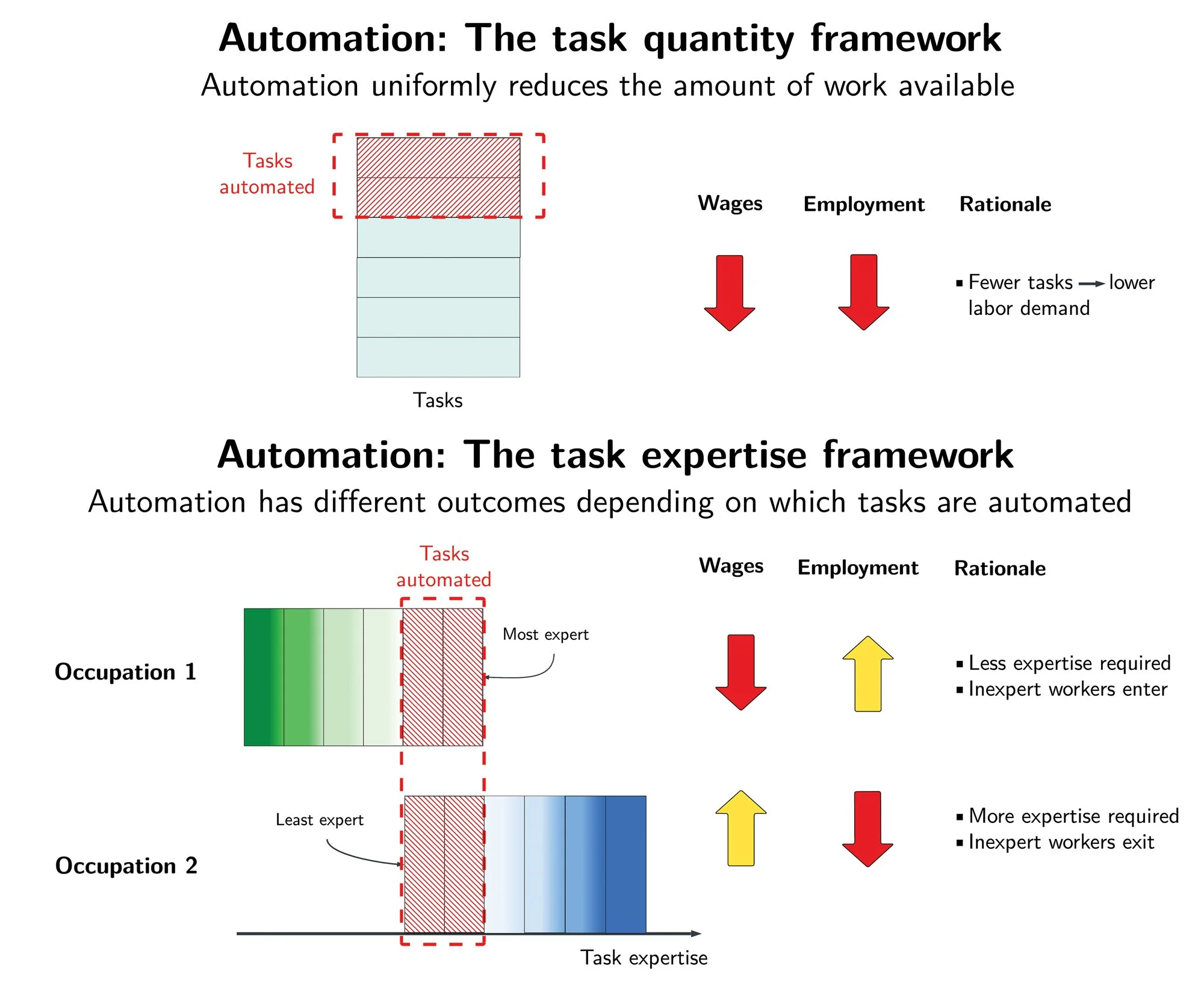
Figure 1. The contrasting wage and employment implications of the task quantity framework versus the task expertise framework.
As illustrated in Figure 1, task quantity frameworks11 do not predict these contrasting effects—though they do have independent explanatory power. Rather than predicting countervailing effects of expertise changes on employment and wages, changes in task quantities predict reinforcing effects: Gaining tasks increases employment (more work to do) and increases wages, whereas losing tasks decreases employment (less work to do) and decreases wages. Task quantity changes act like demand shifts—more tasks mean more work needed. Task expertise changes act like supply shifts—higher requirements mean fewer qualified workers. Both forces operate simultaneously, sometimes reinforcing and sometimes offsetting each other.
The creation of new expertise
Economic literature and popular discussion of the impact of technological change on employment has primarily treated the set of human job tasks as finite and static, implying that as automation proceeds, labor is shunted into an ever-narrowing scope of activities.12 Casual observation and historical evidence suggest otherwise.13 As employment in labor-intensive sectors such as agriculture, textiles, and mining has eroded, the scope and variety of labor-demanding activities has expanded, for example, in medicine, software, electronics, health care, finance, entertainment, recreation, personal care, and other domains.
Consider, for example, that US statistical agencies did not recognize the job of “web designer” before 1990, “social media manager” before 2005, “sommelier” before 2010, “data scientist” before 2018, and “forward deployed engineers” before 2025. These occupations aren’t simply remixes of existing jobs; they encompass new domains of expertise that have emerged as a consequence of evolving technologies, changing tastes, shifting demographics, and the cornucopia of human creativity. Representative evidence across more than eight decades confirms these observations.14
Economists have long derided the so-called “lump of labor fallacy,” which posits that there’s a fixed amount of work to be done—so more automation implies less human work.15 We are equally skeptical of what we believe is an emerging, AI-era manifestation of this notion, the “lump of expertise fallacy,” that posits that there is only so much novel expertise to master. To the contrary, economists have prominently raised the opposite concern, i.e., that the rising burden of knowledge is stifling scientific progress by lengthening the time required for researchers to reach the scientific frontier.16
“When new expertise does emerge, it typically benefits different workers from those whose expertise has recently become obsolete.”
While we reject the expertise fallacy, we do not argue that there is no cause for concern. When new expertise does emerge, it typically benefits different workers from those whose expertise has recently become obsolete. The factory workers displaced by automation rarely became computer programmers. The radiologists whose diagnostic expertise is surpassed by AI probably won’t become AI researchers. This misalignment between who loses as old work is automated and who gains as new work emerges poses society-wide distributional challenges.
Although demand for novel, valuable expertise will surely emerge in the AI era, it may not emerge sufficiently rapidly or be sufficiently accessible to those displaced to offset the aggregate losses, much less the individual losses among those displaced.
III. Seeing AI Through the Expertise Lens
What makes AI different
It is often said that what makes AI distinct from previous technologies is that it imbues machines with capabilities that we have considered uniquely human. This assertion is false. Almost by definition, automation enables machines to perform activities that were heretofore uniquely human, from planting seeds to sewing clothing to operating assembly lines to processing information, to analyzing blood samples to making medical diagnoses.17 Moreover, most human-designed tools—from chainsaws to pocket calculators to airplanes—surpass human capabilities in the tasks for which they are designed. AI is not distinctive in this respect.
A second piece of dubious conventional wisdom is that AI’s progression differs from traditional automation technologies that proceed predictably up the skill ladder. In this telling, workers could therefore see previous waves of automation coming and potentially “skill up” to stay ahead. But history is replete with counterexamples.
In the artisanal era, most goods were handmade by skilled artisans: wagon wheels by wheelwrights; clothing by tailors; shoes by cobblers; timepieces by clockmakers; firearms by blacksmiths. Artisans spent decades mastering their trades, and their expertise was revered in its time. But the value of many forms of artisanal expertise was decimated during the Industrial Revolution of the 18th and 19th centuries. As Joel Mokyr et al. wrote in 2015, “the handloom weavers and frame knitters with their little workshops were quite rapidly wiped out by factories after 1815.”18 Even as industrial-era innovations spurred a surge in productivity, it was five decades before working-class living standards began to rise.19 Thus, in its initial incarnation, the Industrial Revolution displaced expert work while leaving humans to perform the simple, grueling, inexpert work of feeding what Blake termed the “dark satanic mills.”
“What makes modern AI distinct from prior technologies—profoundly so—is that it can acquire knowledge and capabilities inductively, rather than relying on hard-coded formal procedures that are explicitly specified in advance. ”
What makes modern AI distinct from prior technologies—profoundly so—is that it can acquire knowledge and capabilities inductively, rather than relying on hard-coded formal procedures that are explicitly specified in advance. Prior to AI, the primary “tools” we possessed that could learn tacitly from context and experience were work animals, which could learn using onboard hardware not entirely dissimilar from our own. Meanwhile, human-engineered machines were limited to following scripts that people devised based on our explicit, formal understanding of the tasks to be accomplished.
This need for explicit instruction was a binding constraint, because there are many crucial nonroutine tasks that people understand tacitly but for which neither computer programmers nor anyone else can enunciate the explicit “rules” or procedures. When we ride a bicycle, make a compelling argument, recognize a current friend’s face in their baby photograph—we are performing tasks that we understand tacitly but not explicitly how to do. People can achieve mastery through tacit knowledge because they learn by doing. A child doesn’t need to read up on the physics of gyroscopes to learn how to ride a bicycle—simple trial and error will do it. For a computer program to successfully accomplish a task, however, the computer programmer must usually specify all the relevant steps, branches, and exceptions in advance. This observation is known as Polanyi’s paradox, named after the economist, philosopher, and chemist who wrote in 1966, “we know more than we can tell.”20 Following Polanyi’s observation, the tasks that have proved most vexing to automate are those demanding flexibility, judgment, and common sense—capabilities that we possess but do not formally understand.
Though modern AI has yet to match human cognition on many domains, it has arguably overcome Polanyi’s paradox: It is able to learn autonomously, generalize from examples, gain mastery without explicit instruction, and acquire capabilities that it was not explicitly engineered to possess. Whereas in the pre-AI era, programmers struggled to imbue computers with the tacit knowledge needed for accomplishing nonroutine tasks, in the present AI-era, computers can readily acquire this tacit knowledge. Ironically, they cannot (in almost all cases) communicate that knowledge explicitly to people. Thus, computers now know more than they can tell us—what Autor calls Polanyi’s revenge.21
These capabilities make AI more powerful and general than previous automated systems. Whereas previous systems were able to learn from data, they did so in a narrow way—becoming more precise in the parameters they were programmed to estimate. This capped their ability to learn when those parameters only partially described the world. So, for example, a medical diagnosis system that learned to distinguish conditions based on ten variables would never discover that an 11th variable is also a crucial predictor.
Statistically grounded machine learning systems can discover this 11th variable, and many others. They are now highly effective at learning unseen rules that are implicit in data they encounter, whether that be text, computer code, images, or sound. (By “learn,” we mean accurately predict the consequences of such rules; we do not take a philosophical stance on the distinction between learning and understanding.) As such systems encounter more data, they learn both the presence of new (often implicit) rules and make more precise their estimation of existing rules.
While these capabilities are relatively new, their rate of advancement is well predicted by so-called scaling laws. These regularities, based on statistical sampling, describe the rate at which AI systems improve as the quantity of parameters and training data grows.22 Scaling laws provide a roadmap that AI companies are now following to build enormously powerful systems.
“While we can anticipate the trajectory of capabilities that AI is likely to acquire, we have less certainty about what AI will not be able to do, and how important those things will be for the labor market.”
This predictability does not make labor market forecasting straightforward, however. While we can anticipate the trajectory of capabilities that AI is likely to acquire, we have less certainty about what AI will not be able to do, and how important those things will be for the labor market. On the current trajectory, and accounting for the foreseeable acceleration of AI’s progress, we are highly confident that most adults will work for a living in the labor market of 2030 in jobs that are not fundamentally different from the jobs that people perform today. But we are less certain about the labor markets of 2040 and 2050.
Near-term implications
The expertise framework suggests that rather than asking, “Will AI automate this job?,” we should ask instead, “Which tasks within this job will AI automate, and are those the expert or inexpert tasks for this occupation?” Consider the following two countervailing examples.
Software Engineering: AI code-generation tools like GitHub Copilot reshape the expertise landscape, but differently across skill levels. For senior engineers, AI automates relatively inexpert tasks—boilerplate code, syntax lookup, routine debugging. These engineers now focus more on architecture, design, and complex problem-solving. Their productivity and their wages will likely rise as they concentrate on higher-value activities.
For junior engineers, however, AI automates their core expert tasks—the basic programming that traditionally served as their entry point to the profession. Writing functional code was their primary value-add; now AI does it more quickly and cheaply, and may eventually do it better. The expertise framework predicts this will lower entry-level wages while potentially increasing employment as people enter the field who understand what they want to build but lack deep technical skills.
This bifurcation within a single occupation demonstrates why aggregate predictions about “programmers” miss the point. The same tool that enhances senior engineers’ expertise may diminish juniors’ expertise.
This isn’t altogether bad news, but it creates an institutional challenge. In equilibrium, firms cannot hire only workers who have gained experience at other firms. If not at other firms, those workers must acquire their experience somewhere. This is not an insurmountable challenge. We have multiple institutional mechanisms that allow novices to gain experience outside of a conventional employment relationship. For example, formal educational programs, trade apprenticeships, medical residencies, legal clerkships, and flight simulators all supply venues for novices to gain structured, supervised experience before entering the unsheltered labor market. While some of these learning mechanisms are unpaid, and others require prospective workers to pay, such structures can thrive if the value of producing more-expert workers is sufficient. If widespread AI adoption ultimately cuts out rungs on the learning ladder across a broader swath of occupations, we expect that these and other new institutional arrangements will ultimately be deployed to restore those rungs.
Health care: AI diagnostic tools may induce a different kind of outcome. When AI systems can diagnose complex conditions from symptoms, test results, and (eventually) direct interactions with patients—currently among physicians’ expert tasks—the expertise framework predicts that doctors’ wages may fall as their diagnostic monopoly erodes. Simultaneously, nurse practitioners and physician assistants, who are frequently restricted from performing these tasks, may ultimately gain a broader scope of practice (though medical guilds will surely try to block their path). If this broadening is permitted, these practitioners’ earnings could rise as they take on previously exclusive tasks.
“By injecting competition into the current near-monopoly of diagnostic practice among a small number of highly paid specialists, effective use of AI could enable a larger, more distributed workforce to provide quality care.”
The net effect could be profoundly positive for health care access. By injecting competition into the current near-monopoly of diagnostic practice among a small number of highly paid specialists, effective use of AI could enable a larger, more distributed workforce to provide quality care. Rural communities that struggle to attract specialists could receive sophisticated diagnostic capabilities through AI-augmented nurses. The technology could be used to democratize expertise even as it disrupts traditional hierarchies.
This example also underscores that focusing solely on job displacement misses potential benefits for workers themselves as well as consumers (in this case, patients). An Uber-like disruption of professional services—where technology lowers barriers to entry—could benefit the broader workforce even as it creates more competition for incumbent elites. As Milton Friedman is alleged to have said, everyone loves free markets, but everybody hates competition.
IV. Transformative AI and the Future of Expertise
The expertise framework illuminates transitions, showing how automation reshapes the value of human expertise as specific tasks shift from human to machine. But transformative AI promises something qualitatively different: systems that match or exceed human performance across all cognitive tasks. Not just reading X-rays or writing code, but the full spectrum of human intellectual capability. Accepting the idea that the human mind is ultimately a machine, we do not dismiss the possibility that machines may one day mimic all human capabilities and exceed all human capacities.
“Accepting the idea that the human mind is ultimately a machine, we do not dismiss the possibility that machines may one day mimic all human capabilities and exceed all human capacities.”
If transformative AI does arrive, what does this imply for human expertise? The expertise framework, developed for marginal automation, may seem irrelevant in a world where machines can do everything cheaper, better, and faster than humans at everything. But the core insight that scarcity creates value remains essential. The question becomes: What forms of scarcity persist in a world of abundant artificial intelligence, and what social, distributional, and governance challenges (alongside opportunities) does this pose?
Scenario 1: We can’t imagine the jobs of the future
A consistent pattern in technological transformation is our inability to foresee the new forms of work it creates. Few farmers and factory workers of 1900 could have envisioned an economy dominated by services and information where millions work as software engineers, attorneys, cosmetologists, and health technologists—an economy with more than half as many people employed in data science as in farming, fishing, and forestry occupations.23 Similarly, we may be fundamentally unable to imagine the jobs that transformative AI will create.
“ Imagination typically falls short when we try to envision a role for human labor in an increasingly AI-intensive economy because we fixate on what can be automated, i.e., what we are currently doing that we won’t need to do any more.”
Imagination typically falls short when we try to envision a role for human labor in an increasingly AI-intensive economy because we fixate on what can be automated, i.e., what we are currently doing that we won’t need to do any more. But this myopia obscures what makes new technologies fundamentally transformative. Replicating our existing capabilities, simply at greater speed and lower cost, is a useful but comparatively minor achievement. As Brynjolfsson observes, if the ancient Greeks had automated all their productive activities, they would still have lacked flight, telecommunications, and penicillin—the pillars of modernity.24
Rather than merely automating existing tasks, transformative innovations open fundamentally new vistas of human possibility. Guglielmo Marconi’s vision for wireless communications was first and foremost an act of imagination: harnessing newly discovered properties of the electromagnetic spectrum to transmit information across distances without physical substrate. By unlocking new possibilities, these innovations generate new employment and demands for expertise. There were no aircraft crews, household plumbers, geneticists, or television actors until supporting innovations created the need for these specialized skill sets. Approximately 60% of US employment in 2018 was found in occupational specialties that had not yet been invented as of 1940.25
This complementarity between human expertise and new technologies can operate through several channels. The simplest, and often the most desirable, case is where innovations create demand for new human expertise, e.g., the expertise required for flight, medicine, construction, design, entertainment, carework, etc. What makes new work distinct from simply more work is that it imbues labor with new scarcity value; it requires capabilities that are neither already abundantly available nor simply more of the same.26 New expertise demands are therefore the opposite of automation: Rather than reallocating tasks from labor to capital, they instantiate new tasks that specifically require human capabilities. This focus on new expertise demands echoes the prominent role Acemoglu and Restrepo assign to new task creation,27 with the added emphasis that what makes a task new is the novel expertise required.
Even as AI surpasses human capability at many of today’s tasks, entirely new categories of human work may emerge where AI complements rather than supplants human labor. These might involve guiding AI systems, interpreting their outputs for specific contexts, or performing functions we can’t yet conceive. Human agency, values, and judgment may become more, not less, important in an AI-saturated world. Someone must decide what problems AI should solve, what values it should optimize for, and how its capabilities should be deployed.
“What makes new work distinct from simply more work is that it imbues labor with new scarcity value; it requires capabilities that are neither already abundantly available nor simply more of the same.”
As the expertise framework also highlights, automation—the reallocation of tasks from labor to capital—can have nuanced impacts on wages and employment. Automation that eliminates expert tasks makes remaining work simpler and more accessible. Automation that eliminates routine tasks typically increases specialization and amplifies the value of expertise. In either case, the incompleteness of automation means that key tasks requiring human labor remain. Frequently, new expertise is required to work effectively with the capabilities that automation supplies. Mastery of tools thus becomes central to mastery of the craft. As Autor and Manyika discuss, rather than rendering expertise obsolete, many tools in effect collaborate with experts, acting as a lever for their knowledge and shortening the distance between human intention and material result.28
Consider customer service. Brynjolfsson et al.29 find that AI-based customer service tools substantially improve junior agents’ performance—not by making them immediately more effective but by accelerating their path to mastery. Such force multiplication is likely enduring when AI progress is slow, often because economic incentives for system improvements are weak or because achieving human-level performance remains prohibitively expensive.30 In other cases, however, human collaboration with partial automation proves transient. In the games of Chess and Go, there was a brief period when human-machine “centaur” teams outperformed humans or AI alone.31 But rapid AI progress soon rendered centaur teams obsolete. A similar trajectory may now be unfolding in customer service roles. A key question for forecasting future demands for expertise is identifying where AI-human collaboration will offer enduring value and where it represents only a brief waystation between machine-human complementarity and full automation.
Scenario 2: Human labor loses all scarcity value
The pessimistic scenario envisions a world where human labor genuinely loses all economic value. If AI systems can perform any task better, faster, and cheaper than humans, why would anyone pay for human labor? This scenario would not imply an end to scarcity per se; there would still be scarcity of beachfront property in Monterey, scarcity of exclusive experiences, scarcity of status and social esteem. But there would no longer be labor scarcity.
This scenario would shake the foundation of market economies. In canonical economic theory, market operation requires that participants have something valuable to exchange. The labor market is the principal generator of that value: People trade their labor for income, then use that income to purchase goods and services. While this notion may sound quaint, roughly 60% of value-added in contemporary industrialized economies is paid to labor, not capital, despite the vast material riches that industrialized countries possess.32 If human labor’s scarcity value were vacated, most people would have nothing to sell. There would still be economic value in the world, but it would not accrue to labor, and the labor market itself would have no remaining function.
“If human labor’s scarcity value were vacated, most people would have nothing to sell. There would still be economic value in the world, but it would not accrue to labor, and the labor market itself would have no remaining function.”
A world without labor scarcity—Herbert Simon’s “crisis of abundance”—would pose three surpassing social challenges. The first is a crisis of social organization and human purpose. For the fortunate, work provides purpose, community, and esteem. Yet the last four decades have shown that as computerization has marched onward and inequality has risen, the quality, dignity, and respect of a substantial minority of jobs has eroded. If human deployment of AI were to extend this process to its logical limit, it would demand a huge societal adjustment to “refactor” the basis of identity in a world without the structure and incentives provided by work. While the consequences need not be dystopian, there is no certainty that people would be individually or collectively happier when stripped of this foundational structure.
Compounding this uncertainty is a second challenge: A world without labor scarcity is a world with a huge income distribution problem. While there would be many scarce things that are worth having, who would have the resources to purchase them? The answer would depend on how society distributes the value of productive resources that would plausibly be owned by a tiny subset of humanity. While one might imagine that a world of unlimited labor abundance is a world with unlimited generosity, we are skeptical. In the 4th century BC, Aristotle prophesied that if “the shuttle would weave and the plectrum touch the lyre without a hand to guide them, chief workmen would not want servants, nor masters slaves.”33 Yet slavery was not nominally abolished for more than 150 years after the invention of the power loom, and it nevertheless persists today. If we sound unduly pessimistic, imagine a society in which all major resource allocation decisions were made by a trilateral commission of Sam Altman, Elon Musk, and Mark Zuckerberg. While these billionaire entrepreneurs arguably deserve a measure of admiration, one may doubt that a society that depends primarily on their beneficence would be a desirable one.
“We fear that a democracy without a labor market—a democracy where the vast majority of citizens are perceived as claimants but not as gainful contributors—might not survive for long as a democracy.”
This brings us to the third challenge: whether democratic governance can survive the dissolution of the labor market. Democratic legitimacy itself rests partly on the perception that citizen-voters both contribute to and benefit from economic production. Reflecting this bias (among many others), voting rights were limited to land-owning male citizens in most democracies at most points in history. In contemporary democracies, the vote is nominally extended to almost all adult citizens. Nevertheless, in the US in particular, adult citizens of working age who are not gainfully employed are routinely delegitimized by the US legislative process and subject to punitive restrictions. Workers, by contrast, appear to be viewed by the political process as contributors, which in turn gives them the right to make claims on society’s largess. We fear that a democracy without a labor market—a democracy where the vast majority of citizens are perceived as claimants but not as gainful contributors—might not survive for long as a democracy.
While this scenario of a complete elimination of labor scarcity is extreme, it’s plausible that countries might reach a crisis point well before AI makes all human labor obsolete. Were labor’s share of national income to fall precipitously in the decade or two ahead, it’s plausible that the political economy of democratic countries would founder even while human work remains.
Policy implications: Preparing for Knightian uncertainty
Given this fundamental uncertainty about transformative AI’s impact, what policies make sense today? We need approaches that work across multiple scenarios, from gradual automation to complete human labor obsolescence.
Hedging our labor bets
A first proposal is to move beyond the Universal Basic Income (UBI) debate. While UBI might partly address the income distribution problem by taxing rich capital owners and redistributing the resources to non-workers, UBI doesn’t solve the deeper political economy challenges of vast inequality of resource ownership and waning democratic legitimacy in a post-labor world.
Consider instead Universal Basic Capital (UBC): granting every person a meaningful ownership stake in productive
assets from birth.34 Unlike UBI, which requires continuous political support for redistribution, UBC creates long-term stakeholders in the automated economy. People would own shares in the machines and algorithms that displaced human labor, receiving dividends from increased productivity.
This ownership structure addresses multiple challenges. It provides income through capital returns rather than ongoing transfers, reducing political vulnerability. It diffuses capital ownership broadly, thus reducing concentration of ownership rights. It maintains market mechanisms by ensuring everyone has assets to trade. It potentially preserves democratic legitimacy by ensuring that citizens are owners of productive resources, not simply claimants. Finally, it serves as a hedge against labor income risk, which is critical since labor income is the principal asset stream upon which most working-age adults rely. Whether the value of labor falls across the board (as many predict) or rises for some and falls for others (as is certain), hedging that risk with broader capital ownership surely makes sense. And if labor is expected to fall in value because AI capital will displace it, then hedging labor income with capital ownership is an especially good idea.
“If UBC were issued immediately to recent and future birth cohorts, it would still take multiple decades for capital ownership rights to be broadly diffused. We should therefore begin experimenting with these structures now.”
The implementation details matter enormously, of course. The ownership stakes must be substantial enough to provide meaningful income and influence—not token amounts that leave real control with a few large shareholders. These stakes must be structured to prevent immediate consolidation through sales to wealthy buyers. And they must include governance rights, not just passive income streams. Several variants deserve study: sovereign wealth funds that distribute shares to citizens, public options for AI development that grant ownership to users, requirements that companies above certain valuations distribute equity to broader stakeholders. If UBC were issued immediately to recent and future birth cohorts, it would still take multiple decades for capital ownership rights to be broadly diffused. We should therefore begin experimenting with these structures now.
Supporting worker transitions
As expertise requirements shift rapidly across occupations, we need policies that smooth the adjustment. While there is a standard toolkit for facilitating such transitions—unemployment insurance, retraining programs, career counseling (perhaps AI-powered)—they typically fail to address a key barrier to taking new work. When workers are displaced from career work due to trade shocks, technological obsolescence, or the sunsetting of industries or trades, this generally means that their expertise has lost market value. Indeed, workers who change occupations after job loss exhibit substantial wage scarring.35 Recognizing this risk, many displaced workers face a painful choice between searching for job opportunities that may no longer exist and accepting significant, lasting wage cuts.
Wage insurance offers a bridge between these two outcomes by subsidizing the wage gap when workers return to employment at lower pay. Kletzer and Litan are credited with articulating the first formal wage insurance policy design,36 but evidence on the policy’s efficacy was lacking until recently. As documented by Hyman, Kovak and Leive,37 a wage insurance program implemented by the Obama administration, Reemployment Trade Adjustment Assistance (RTAA), provides strong evidence of substantial benefits. Under the design of RTAA, workers who were involuntarily displaced by trade and found reemployment at a lower wage were eligible to receive payments covering 50% of the difference between their old and new wages, subject to reasonable caps on duration (such as two years).
This incentive structure proved effective. Trade-displaced workers who were eligible for RTAA returned to employment significantly faster—roughly one calendar quarter sooner—and earned approximately $18,000 more over four years than comparable workers without access to wage insurance, not counting the insurance payments themselves. These effects stemmed primarily from shorter unemployment spells rather than workers taking worse jobs; in fact, there is no evidence that wage insurance led to lower-quality employment, nor that it trapped workers in declining industries. Neither, however, did it appear to move workers back up the job ladder more quickly than comparable workers who, due to their age or prior earnings, were not entitled to this benefit. Critically, the program proved self-financing when accounting for reduced unemployment insurance payments and increased tax revenues from higher employment.
A similar wage insurance program could be folded into the US unemployment insurance system. These benefits would be available only to workers who are displaced involuntarily—not by choice, and not for cause—and paid only to those who take new jobs during the post-displacement eligibility period. Unlike conventional unemployment insurance that ends when someone finds new work, wage insurance benefits would take effect when a worker reenters employment. This would create a powerful incentive to return to work quickly, even at a somewhat lower wage. It would also partly cushion the psychological blow of lower earnings by making up part of the financial loss. And it would potentially enable workers to continue rebuilding their careers and potential transition to higher earnings without enduring the scarring effects of prolonged unemployment.
“Harnessing rapidly advancing AI and AR tools, and steering them with public investment or publicly orchestrated innovation grants and prizes, would enable more people to master new expertise by doing rather than by studying.”
Wage insurance provides a net, but it does not provide a ladder. Education and training systems can provide that ladder, but they require innovation. With proper design, AI holds great promise as a tool for enabling workers to acquire expertise efficiently and deploy it effectively. One avenue for applying AI for training innovation is in expanding the use of simulation training. Simulation training is deployed at present mainly in settings where it would be too risky to do otherwise, e.g., airplane flight simulators for pilots, and, in medicine, animatronic mannequins that breathe, bleed, blink, speak, and convulse. Harnessing rapidly advancing AI and AR tools, and steering them with public investment or publicly orchestrated innovation grants and prizes, would enable more people to master new expertise by doing rather than by studying. As one example, Moghaddam et al.38 show that Augmented Reality (AR) is far more effective as a workplace-based learning and training technology than classroom training in helping workers master manufacturing tasks that involve both complex manipulation and reasoning. Such training could be particularly valuable if there is expertise that AI can teach but not do, as it would accelerate workers’ ability to develop AI-resistant expertise.
V. Conclusion: The Work of the Future
The history of automation underscores a fundamental truth: Technology’s impact on workers depends not only on what is automated but also on what remains. When automation eliminates an occupation’s simplest tasks, workers must become more expert, wages rise, and fewer people qualify. When it eliminates the most complex tasks, work becomes more accessible, wages fall, and employment expands. This expertise framework explains why accounting clerks and inventory clerks—both exposed to routine task automation—experienced opposite fates. But automation isn’t everything. New task creation is essential, though the mechanisms for eliciting it are more elusive.
“The history of automation underscores a fundamental truth: Technology’s impact on workers depends not only on what is automated but also on what remains.”
As the philosopher Joshua Cohen has frequently said, the future is not a forecasting problem but a design problem.39 We might harness transformative AI to create abundance beyond imagination or inequality beyond tolerance. We might apply it to democratize expertise or to concentrate power. We might use it to enhance human capability or render it obsolete. Most likely, we’ll experience some complex combination of these outcomes: Certain human capabilities will rise in value, others will be rendered obsolete, and new variants of expertise will emerge that leverage human-AI collaboration. But even if the net effect of these transformations on work and workers is on average positive, few workers will experience the average. Surely, some will see their expertise devalued while others will ride the wave of new expertise creation.
We remain optimistic that humanity is not converging rapidly to the end of labor scarcity, but we recognize that a risky technological and economic transition is already underway—one with vast upside benefits and vast downside risks that will land unevenly on individuals, demographic groups, nations, and generations. We should hedge our bets using policies that work across multiple scenarios. For industrialized countries like the US, this means capital hedges to diversify labor income, wage insurance to ease employment transitions, and investment in educational innovations to support expertise acquisition.
Yet these hedges would do nothing for most of the world’s workers—even though they face the same labor income risks from the breakneck pursuit of artificial general intelligence by two industrialized countries in particular. If the rapid erosion of labor scarcity would pose grave challenges for workers in wealthy nations with strong safety nets, the risks for the developing world are far greater.
“We remain optimistic that humanity is not converging rapidly to the end of labor scarcity, but we recognize that a risky technological and economic transition is already underway—one with vast upside benefits and vast downside risks that will land unevenly on individuals, demographic groups, nations, and generations.”
1. We are indebted to Lucy Hampton and Can Yeşildere for extensive input and assistance that improved this manuscript.
2. David H. Autor and Neil Thompson, “Expertise,” Journal of the European Economic Association 23, no. 4 (2025): 1203-1271, https://doi.org/10.1093/jeea/jvaf023.
3. Herbert. A. Simon, “‘Automation’ (A Letter in Response to ‘Where Do We Go From Here?’ from the March 17, 1966 Issue),” New York Review of Books, May 26, 1966, https://www.nybooks.com/articles/1966/05/26/automation-3/.
4. “Amazon Workers Face ‘Increased Rates’ of Mental Illness,” BBC, November 25, 2013, https://www.bbc.com/news/business-25034598.
5. Karen Weise, “Amazon Plans to Replace More Than Half a Million Jobs with Robots,” New York Times, October 25, 2025, https://www.nytimes.com/2025/10/21/technology/inside-amazons-plans-to-replace-workers-with-robots.html.
6. Carl Benedikt Frey and Michael A. Osborne, “The Future of Employment: How Susceptible Are Jobs to Computerisation?,” Technological Forecasting and Social Change 114 (January 2017): 254–280, https://doi.org/10.1016/j.techfore.2016.08.019.
7. Daron Acemoglu and Pascual Restrepo, “The Race Between Man and Machine: Implications of Technology for Growth, Factor Shares, and Employment,” American Economic Review 108, no. 6 (2018): 1488–1542, https://doi.org/10.1257/aer.20160696.
8. Autor and Thompson, “Expertise.”
9. David H. Autor, Lawrence F. Katz, and Melissa S. Kearney, “The Polarization of the US Labor Market,” American Economic Review: Papers & Proceedings 96, no. 2 (2006): 189–194, https://doi.org/10.1257/000282806777212620; Maarten Goos and Alan Manning, “Lousy and Lovely Jobs: The Rising Polarization of Work in Britain,” Review of Economics and Statistics 89, no. 1 (2007): 118–133, https://doi.org/10.1162/rest.89.1.118; Maarten Goos, Alan Manning, and Anna Salomons, “Job Polarization in Europe,” American Economic Review: Papers and Proceedings 99, no. 2 (2009): 58–63, https://doi.org/10.1257/aer.99.2.58.
10. Other ingenious explanations, focused on changing occupation composition and self-selection, have been offered: Guido Matias Cortes, “Where Have the Middle-Wage Workers Gone? A Study of Polarization Using Panel Data,” Journal of Labor Economics 34, no. 1 (2016): 63–105, https://doi.org/10.1086/682289; Michael J. Böhm, “The Price of Polarization: Estimating Task Prices Under Routine-Biased Technical Change,” Quantitative Economics 11, no. 2 (2020): 761–799, https://doi.org/10.3982/QE1031; Michael J. Böhm, Hans-Martin von Gaudecker, and Felix Schran, “Occupation Growth, Skill Prices, and Wage Inequality,” Journal of Labor Economics 42, no. 1 (2024): 201–243, https://doi.org/10.1086/722084; Oren Danieli, “Skill-Replacing Technology and Bottom-Half Inequality,” working paper, Tel Aviv University, May 2025.
11. Daron Acemoglu and David Autor, “Skills, Tasks and Technologies: Implications for Employment and Earnings,” in Handbook of Labor Economics, vol. 4 (Elsevier, 2011): 1043–1171; Daron Acemoglu and Pascual Restrepo, “The Race Between Man and Machine: Implications of Technology for Growth, Factor Shares, and Employment,” American Economic Review 108, no. 6 (2018): 1488-1542, https://doi.org/10.1257/aer.20160696; Daron Acemoglu and Pascual Restrepo, “Automation and New Tasks: How Technology Displaces and Reinstates Labor,” Journal of Economic Perspectives 33, no. 2 (Spring 2019): 3–30, https://doi.org/10.1257/jep.33.2.3.
12. Daniel Susskind, “A Model of Technological Unemployment,” Economics Series Working Papers 819, no. 10.1017 (May 2017), https://api.semanticscholar.org/CorpusID:44650688.
13. Jeffrey Lin, “Technological Adaptation, Cities, and New Work,” Review of Economics and Statistics 93, no. 2 (2011): 554–574, https://doi.org/10.1162/REST_a_00079; Acemoglu and Restrepo, “The Race Between Man and Machine”; Acemoglu and Restrepo, “Automation and New Tasks.”
14. See, among others, Lin, “Technological Adaptation, Cities, and New Work”; Enghin Atalay, Phai Phongthiengtham, Sebastian Sotelo, and Daniel Tannenbaum, “The Evolution of Work in the United States,” American Economic Journal: Applied Economics 12, no. 2 (2020): 1–34, https://doi.org/10.1257/app.20190070; David H. Autor, Caroline Chin, Anna Salomons, and Bryan Seegmiller, “New Frontiers: The Origins and Content of New Work, 1940–2018,” Quarterly Journal of Economics 139, no. 3 (2024): 1399–1465, https://doi.org/10.1257/000282806777212620; David H. Autor, Caroline Chin, Anna Salomons, and Bryan Seegmiller, “What Makes New Work Different from More Work?,” Annual Review of Economics, 2025, forthcoming.
15. David Schloss, “Why Working Men Dislike Piece-Work,” The Economic Review 1, no. 3 (July 1891): 311–326.
16. Benjamin F. Jones, “The Burden of Knowledge and the ‘Death of the Renaissance Man’: Is Innovation Getting Harder?,” Review of Economic Studies 76, no. 1 (2009): 283–317, https://doi.org/10.1111/j.1467-937X.2008.00531.x.
17. Qualifying slightly, some automation replaced capabilities provided by beasts of burden.
18. Joel Mokyr, Chris Vickers, and Nicolas L. Ziebarth, “The History of Technological Anxiety and the Future of Economic Growth: Is This Time Different?,” Journal of Economic Perspectives 29, no. 3 (2015): 31–50, https://doi.org/10.1257/jep.29.3.31.
19. Robert C. Allen, “Engels’ Pause: Technical Change, Capital Accumulation, and Inequality in the British Industrial Revolution,” Explorations in Economic History 46, no. 4 (2009): 418–435, https://doi.org/10.1016/j.eeh.2009.04.004.
20. Michael Polanyi, The Tacit Dimension (Doubleday, 1966); David H. Autor, “Why Are There Still So Many Jobs? The History and Future of Workplace Automation,” Journal of Economic Perspectives 29, no. 3 (2015): 3–30, https://doi.org/10.1257/jep.29.3.3.
21. David H. Autor, “The Labor Market Impacts of Technological Change: From Unbridled Enthusiasm to Qualified Optimism to Vast Uncertainty,” Working Paper No. 20074 (National Bureau of Economic Research, July 2022), https://doi.org/10.3386/w30074.
22. Jonathan S. Rosenfeld, Amir Rosenfeld, Yonatan Belinkov, and Nir Shavit, “A Constructive Prediction of the Generalization Error Across Scales,” preprint, arXiv, December 20, 2019, https://arxiv.org/abs/1909.12673.
23. U.S. Bureau of Labor Statistics, “Occupational Outlook Handbook: Data Scientists,” last modified August 28, 2025, https://www.bls.gov/ooh/math/data-scientists.htm; U.S. Bureau of Labor Statistics, “Occupational Employment and Wage Statistics,” last modified April 3, 2024, https://doi.org/10.1257/000282806777212620.
24. Erik Brynjolfsson, “The Turing Trap: The Promise and Peril of Human-Like Artificial Intelligence,” in eds. Daniel Araya and Peter Marber, Augmented Education in the Global Age (Routledge, 2023): 103–116.
25. Autor, Chin, Salomons, and Seegmiller, “New Frontiers: The Origins and Content of New Work, 1940–2018.”
26. Autor, Chin, Salomons, and Seegmiller, “What Makes New Work Different from More Work?”
27. Acemoglu and Restrepo, “The Race Between Man and Machine”; Acemoglu and Restrepo, “Automation and New Tasks.”
28. David H. Autor and James Manyika, “A Better Way to Think About AI: Artificial Intelligence Is Ready to Collaborate. Why Fixate on Automation?,” The Atlantic, August 24, 2025, https://www.theatlantic.com/technology/archive/2025/08/ai-job-loss-human-enhancement-google/683963/.
29. Erik Brynjolfsson, Danielle Li, and Lindsey Raymond, “Generative AI at Work,” Quarterly Journal of Economics 140, no. 2 (2025): 889–942, https://doi.org/10.1093/qje/qjae044.
30. Neil Thompson, Danial Lashkair, and Omeed Maghzian, “Discussion: ‘We Won’t Be Missed: Work and Growth in the Era of AGI’ by Pascual Restrepo,” National Bureau of Economic Research Conference on Transformative AI, October 2025, https://www.nber.org/system/files/chapters/c15315/c15315.pdf; Maja Svanberg, Wensu Li, Martin Fleming, Brian Goehring, and Neil Thompson, “Beyond AI Exposure: Which Tasks Are Cost-Effective to Automate with Computer Vision?,” working paper, January 2024, https://doi.org/10.2139/ssrn.4700751.
31. Andreas Haupt and Erik Brynjolfsson, “A Case for Centaur Evaluations,” in NeurIPS 2025 Workshop on Evaluating the Evolving LLM Lifecycle: Benchmarks, Emergent Abilities, and Scaling (September 2025), https://openreview.net/forum?id=KiuJy4lF9R.
32. David H. Autor, David Dorn, Lawrence F. Katz, Christina Patterson, and John Van Reenen, “The Fall of the Labor Share and the Rise of Superstar Firms,” Quarterly Journal of Economics 135, no. 2 (2020): 645–709, https://doi.org/10.1093/qje/qjaa004.
33. Aristotle, The Politics of Aristotle, trans. Benjamin Jowett (Clarendon Press, 1885), Book 1, Chapter 4 (1253b33–1254a1).
34. See Nathan Gardels, “New Deal 2.0: Make Labor Capitalists,” Noēma, April 9, 2021, https://www.noemamag.com/new-deal-2-0-make-labor-capitalists/; Nicolas Berggruen, “Universal Basic Capital Would Create a Fair AI Economy,” Financial Times, October 31, 2025, https://www.ft.com/content/9b93e02a-c693-4070-9094-a2f532dfa929.
35. Christopher Huckfeldt, “Understanding the Scarring Effect of Recessions,” American Economic Review 112, no. 4 (2022): 1273–1310, https://doi.org/10.1257/aer.20160449.
36. Lori G. Kletzer and Robert E. Litan, “A Prescription to Relieve Worker Anxiety,” Policy Brief 01-02, Peterson Institute for International Economics, March 2001, https://www.piie.com/publications/policy-briefs/prescription-relieve-workeranxiety.
37. Benjamin G. Hyman, Brian K. Kovak, and Adam Leive, “Wage Insurance for Displaced Workers,” Working Paper No. 32464 (National Bureau of Economic Research, May 2024), http://www.nber.org/papers/w32464.
38. Mohsen Moghaddam, Nicholas C. Wilson, Alicia Sasser Modestino, Kemi Jona, and Stacy C. Marsella, “Exploring Augmented Reality for Worker Assistance Versus Training,” Advanced Engineering Informatics 50 (October 2021): 101410, https://doi.org/10.1016/j.aei.2021.101410.
39. As quoted in Michelle Mohney, “What AI Means for the Future of Work: HDI+C Panel with David Autor and Eric Horvitz,” Northwestern McCormick School of Engineering, May 4, 2025, https://www.mccormick.northwestern.edu/news/articles/2025/03/what-ai-means-for-the-future-of-work/.
