

How do we share prosperity in society if work no longer sits at the center of people’s lives? In this essay, Anna Yelizarova1 explores one provocative possibility: a “global dividend.” If transformative AI shows little respect for national borders, with effects that spill across countries, then we need a global mechanism that is capable of sharing prosperity out across those borders as well. The idea has precedents—but the practical challenge of implementing it would be immense.
Global Economic Transition We’re Not Ready For
Over the past decade, the conversation around artificial intelligence has been dominated by a familiar set of concerns: breakthroughs in machine learning, competitive pressures between AI companies, and the problem of governing rapidly advancing systems that even their creators don’t fully understand. Yet far less attention has been paid to a more profound, systemic question: How will AI transform the economic foundations of society—and how should we prepare?
No one can predict the future with certainty. But one scenario that deserves far more attention is the possibility that transformative AI (TAI)2 could dramatically reduce the role of human labor in the economy.3 What happens if machines can do an increasing portion of economically valuable work better, faster, and cheaper than people? How would we distribute wealth, maintain social cohesion, and preserve human dignity in a world where labor is no longer the organizing principle of economic life?
Importantly, this isn’t some fringe worry. It’s a design goal, embedded in the mission statements of leading AI companies. OpenAI’s charter,4 for instance, explicitly commits to building systems that “outperform humans at most economically valuable work.” We might be approaching a world where advanced AI could function less like a tool and more like a drop-in replacement for a white-collar worker—a shift that researchers at leading AI companies have come to expect in the next few years.5 This is a more profound disruption than most current economic policy debates are accounting for, but that’s precisely why it requires our attention.
Whether this is just around the corner or still decades away, the pursuit of this future is already underway,6 and the fact that it has attracted exceptional talent and unprecedented funding7 should give us pause. This raises urgent questions about what happens if the AI companies succeed in their stated goal, questions that should be
addressed before such capabilities are realized.
The dominant public narrative has been: If AI takes all the jobs, we’ll simply fund universal basic income (UBI) with the resulting gains in productivity. This essay examines that story seriously and aims to answer tangible questions: What scale of resources would be required to sustain a population through redistribution alone? How would such a system work in practice? And under what future conditions could this become possible? Its goal is not to advocate for this outcome, but to interrogate its assumptions—to pose the difficult questions that must be answered if such a world ever comes to pass.
“European software developers, Indian call center workers, and Mexican factory operators could all find themselves displaced by the same AI systems developed in Silicon Valley, without their countries being able to capture or tax the resulting productivity gains.”
Most UBI debates and experiments usually unfold within national borders. Automation, by contrast, is a borderless force, and the wealth it creates may not accrue evenly. Both the benefits and the disruption from transformative AI will be globally asymmetric.8 European software developers, Indian call center workers, and Mexican factory operators could all find themselves displaced by the same AI systems developed in Silicon Valley, without their countries being able to capture or tax the resulting productivity gains. When millions lose purchasing power, then demand collapses, supply chains fracture, and the cycles that keep markets alive break down.
And if this happens faster than our usual adjustment mechanisms can handle, it will create a pressure for new systems of redistribution at a previously unthinkable scale.
This essay does not attempt to predict when, or even whether, such capabilities will arrive. Rather, it asks what societies could do if they do: how to navigate a transition from economies organized around human work to ones where work plays a far smaller role. To ground that question, it advances one concrete proposal—a global dividend system—and examines whether the economics could actually work.
Defining the World We’re Planning For: An Economy Shaped by TAI
Too often, debates about AI and the economy break down because of unspoken differences in assumptions about dominant risks, timelines, or where the disruption will hit.
Some economists imagine a substantial wave of job displacement offset by even greater job creation.9 Others see a future where AI could make human labor largely obsolete.10 Still others anticipate a world with relatively high employment, but where wages stagnate and the quality of jobs erodes. These futures demand different responses, from retraining to redistribution and taxation reform—and without clarity about which one we’re planning for, it can be hard to have a coherent conversation about policy, let alone priorities.
So let’s be specific about the scenario this proposal engages with: It’s a world where advanced AI systems can perform a growing share of economically valuable tasks and, in doing so, generate vast new wealth.11 These systems go far beyond drafting emails or debugging code, but to coordinating logistics, optimizing business strategy, designing drugs, producing media, and autonomously completing complex, multi-week projects more efficiently and cost-effectively than humans.12 In this world, AI is a force of automation rather than augmentation, and labor’s role in value creation shrinks significantly, wages further decouple from productivity, and the share of income flowing to workers declines as wealth accrues to capital owners.13
In this world, wage-based incomes could stagnate or fall, even as goods and services become cheaper to produce. If purchasing power falls faster than prices, cheaper goods won’t translate to greater well-being.14 And so we may find ourselves in a paradox: high productivity, low demand. What happens to supply chains, investment, and economic dynamism when consumer demand falters, not from scarcity, but from exclusion?
“We may find ourselves in a paradox: high productivity, low demand. What happens to supply chains, investment, and economic dynamism when consumer demand falters, not from scarcity, but from exclusion?”
At the same time, wealth would begin to concentrate among the firms best positioned to benefit from TAI.15 An early glimpse into pricing models16 suggests that access to the most capable systems might remain at the level of firms and out of reach for most individuals. The result may be a bifurcated economy, where a minority of firms operate at superhuman efficiency, while the majority struggle with weakened demand and eroding margins.
Meanwhile, governments could face a growing fiscal squeeze. Most states rely heavily on income taxes to fund public programs17 while often failing to capture corporate profits effectively due to tax loopholes, profit shifting, and relatively low rates on business income.18 In the United States, for example, nearly half of all federal revenue is raised through income tax.19 As AI reduces the role of human labor and allows companies to operate with fewer employees, this setup begins to break down. With less income to tax from workers, government revenues decline just as the demand for public support rises. In many countries, social safety nets are already fragile. Without reform, the gap between what governments can provide and what people need is likely to widen.
Additionally, countries home to leading AI companies and digital infrastructure may capture a disproportionate share of the economic value.20 Others, especially those reliant on cheap human labor or foreign remittances,21 would struggle to adapt.
For decades, firms have moved production to countries with lower wages, offshoring to reduce labor costs.22 But in a world where robotics and automation continue to advance, that trend could reverse.23 If machines can undercut even the lowest wage floors, it might become more cost-effective for companies to bring production back home. That shift wouldn’t just simplify logistics; it could undermine the foundations of economic growth in many parts of the Global South, where export-driven industrial jobs have long been central to national development.24 If those jobs were to disappear without new ones rising in their place, the social and economic consequences could be profound.
Many governments in the Global South already face strained budgets and limited capacity to deliver large-scale social support. And yet the economic asymmetry is likely to deepen—even by most conservative accounts. PwC estimates that AI could add $15.7 trillion to global GDP by 2030, but just $1.7 trillion of that is projected to reach the Global South (excluding China).25 The divide is not just about money but also about the tools for resilience, fiscal capacity, and institutional readiness.
Even among high-income economies, exposure will vary sharply. Countries with strong social systems but limited stakes in frontier AI development, many in Europe and parts of East Asia, could face fiscal and employment shocks as white-collar service exports, professional work, and tax bases erode. Their challenge is not technological catch-up, but sustaining welfare states and middle-class employment when productivity gains accrue elsewhere.
This scenario shouldn’t be treated as a forecast, and it certainly isn’t the only future we should prepare for. A more decentralized world, where the economic gains from AI are distributed more broadly across regions, sectors, and societies and where access to powerful AI is widespread, or one where AI is a force for augmentation rather than automation would bring its own economic dynamics and governance challenges. The goal isn’t to bet on one outcome, but to map the range of plausible trajectories where our current institutions fall short.
But across many trajectories, one thing is consistent: We’re entering a world our existing institutions weren’t designed to navigate.
Beyond Borders: Distributing Value Through a Global Dividend
The next decade will determine whether AI becomes the greatest force for shared prosperity in human history or the greatest engine of inequality. While we are still early in TAI’s development, now is the time to consider novel ownership structures. A global dividend system offers one such path.
A global dividend system would deliver recurring payouts to individuals, grounded in the principle that every person holds a legitimate claim to a share of the value created by transformative technologies. This isn’t about charity; it’s about recognizing that modern AI systems are built atop shared infrastructure, public data, and a long arc of collective human knowledge. If AI companies want broad exemptions from copyright law, while the rest of society wants a living income, then the political question becomes: Why not exchange one for the other?
“If AI companies want broad exemptions from copyright law, while the rest of society wants a living income, then the political question becomes: Why not exchange one for the other? ”
The institutional form this might take is still experimental, but one early vision resembles a sovereign wealth fund: a vehicle to hold and grow AI-driven economic surplus, not in the name of any one country, but in service of humanity as a whole. And while the global scale is unprecedented, the core idea is not.
Existing models of shared wealth and historical precedents
Alaska’s Permanent Fund Dividend, for example, distributes annual cash payouts, typically between $1,000 and $2,000, to every resident, funded by the state’s oil revenues.26 These payments are statutory, not contractual: Alaskans do not hold formal ownership, and the state can reduce or pause distributions during budget crises.
By contrast, the Eastern Band of Cherokee Indians distributes income dividends, ranging from $3,000 to $6,000 twice per year, from a sovereign wealth fund built on casino revenues. These dividends are protected under tribal law, with community-led governance and legal entitlements. Children’s shares are placed in trust and accessed at adulthood, often with financial literacy training required.27 It’s a powerful model of how sovereign wealth can be shared directly and intergenerationally.
Norway offers another example at a much larger scale. Its Government Pension Fund Global, the world’s largest sovereign wealth fund, now holds close to $2 trillion in assets. Each year, the government withdraws about 3% of its value, roughly $50–60 billion, to support the national budget. Those transfers cover about 20% of public spending, financing everything from welfare and health care to education and infrastructure, while preserving the fund’s principal for future generations. In principle, every country could replicate this model (perhaps with AI instead of oil) by pooling a share of the economic surplus into a common fund. But unlike Norway, most governments today lack the upfront capital to seed such a fund, and nearly half the world’s population still lives on less than $8 a day—far from a position to invest.
One of the key challenges will be legal: How do we codify the idea that every person has a rightful economic stake in this emerging infrastructure? That will require international cooperation and creative legal thinking to embed personhood-based entitlements into a durable and enforceable institutional framework. This reframes economic inclusion as a fundamental human right: a form of economic membership in a shared global system.
History also offers lessons in how wealth-sharing mechanisms can fail depending on design. After the fall of the Soviet Union, Russia launched a bold experiment in voucher privatization: distributing shares of state-owned companies to citizens to jump-start a market economy.28 But with little public education, most people, unfamiliar with markets and in dire need for cash, sold their vouchers cheaply to brokers. The result was a dramatic concentration of wealth and the rise of the Russian oligarchy.
The lesson is clear: Redistribution mechanisms need to be trusted, understood, and protected before value is captured. But it also suggests a deeper design principle—ownership models that rely on individual management of complex financial assets can quickly reproduce inequality. When prosperity is measured in compute clusters and equity stakes, it risks becoming untethered from the material well-being of citizens. People cannot eat GPUs.
In contrast, a dividend-based system distributes value without requiring each person to hold or trade ownership stakes. It converts collective wealth into stable, recurring income, shielding people from speculation and unequal financial literacy while preserving a sense of shared entitlement. Rather than turning everyone into a shareholder in name, it makes everyone a beneficiary in practice.
These examples show that shared wealth models are feasible within existing economies. But if TAI alters the foundation of value creation itself, the logic of redistribution must also evolve.
Rethinking dividends in a post-labor economy
A dividend is a mechanism through which a company shares a portion of its profits with shareholders, with the remainder reinvested or held in reserves. Now imagine a radical extension of that idea: Instead of income flowing primarily through wages or taxation, humanity could collectively hold an index fund of global capital, investing uniformly across the world economy. Such redistribution would not only be equitable but could also stabilize demand and sustain economic dynamism in a world where wages no longer fund consumption.
One path is regulatory: If labor’s share of income falls below a socially sustainable threshold, we could legally mandate that a fixed portion of all corporate equity, say 10–20%, be held in collective or public trust(s), representing “humanity’s share” of the productive base. These shares pay out universal dividends, transforming corporate profits into a steady global income stream. Private wealth would still retain a generous portion of ownership, but the structure of capitalism itself would shift to ensure that economic systems continue to serve human welfare, even when human labor is no longer essential to production.
This isn’t completely outside the Overton window. Even some industry leaders have gestured toward exploring ownership-based models. OpenAI CEO Sam Altman, for instance, proposed in “Moore’s Law for Everything” that large corporations be made to provide equity stakes to a public fund, which could make annual distributions to all US citizens.29 His proposal was national in scope, but the underlying intuition applies more broadly: Alignment and inclusion may depend not just on access, but on ownership. OpenAI’s own capped-profit structure and nonprofit foundation can be read in a similar spirit—an attempt, however limited, to embed public-benefit considerations into the governance of a frontier AI company.
This may sound radical by today’s standards. Yet if we envision a future in which a portion of humanity no longer needs to work, then it becomes necessary to ensure that the entities we create, from corporations to AI-driven production systems, remain aligned with human flourishing. The dividend, reimagined, could become the cornerstone of a post-labor social contract: the mechanism by which the wealth generated by nonhuman labor continues to sustain all of humanity.
Toward an institutional vessel
It would be impractical for every corporation to directly distribute shares or dividends to billions of people. Instead, humanity may need an institutional vessel that can hold, govern, and distribute the collective ownership stake of people in an AI-driven economy.
Such an institution could be structured to receive a fixed portion of corporate equity as a universal endowment. Its returns would then be used to fund a global dividend, providing income to all humans irrespective of employment. One possible implementation would have it operate under a sovereign charter, designed to prevent unilateral withdrawal or political interference, with clear fiduciary duties to act on behalf of humanity.
“Humanity may need an institutional vessel that can hold, govern, and distribute the collective ownership stake of people in an AI-driven economy.”
A useful historical precedent can be found in the Bank for International Settlements (BIS), an institution that emerged from an earlier moment of global economic reorganization.30 The BIS was established in 1930 under the Young Plan, originally to manage Germany’s World War I reparations payments and to serve as a clearing house for international settlements among central banks. Although its founding purpose quickly became obsolete as the Great Depression unfolded, the BIS adapted, becoming a neutral financial intermediary that facilitated cooperation among central banks at a time when no comparable global structure existed.
Crucially, the BIS represents a unique form of sovereignty. It is jointly owned by member central banks, operates under an international charter granting it legal immunities,31 and sits “above” national legal systems. Its Swiss headquarters are inviolable, and disputes with the Swiss state are referred to a designated arbitral tribunal rather than domestic courts.32 It is, among other things, a supranational escrow—a trusted third party capable of managing shared value between entities that otherwise operate under competing jurisdictions. The BIS thus demonstrates that supranational financial architectures can persist across jurisdictions, as a neutral third party mediating shared value.
A sovereign global dividend institution could become the backbone of an AI-era social contract: a neutral, legally protected entity that transforms the output of nonhuman labor into shared prosperity. Building something like this wouldn’t be easy. It would require legal imagination, international coordination, and public trust. It would likely face political resistance from those reluctant to cede sovereignty, and from industries wary of redistribution. But the idea rests on a principle that deserves more space in our collective imagination: collective stewardship of shared wealth in an era of massive disruption.
The Mathematics of Redistribution
A common critique of universal redistribution is that there simply isn’t enough money to fund it worldwide. In today’s economy, that’s true. But this essay asks a different question: Under what future conditions could large-scale redistribution become feasible?
In a world calibrated for TAI, far higher productivity becomes not just plausible but likely. If human labor ceases to be the bottleneck across major sectors and AI drives large efficiency gains, the result could be vast new wealth that doesn’t exist today. Technologists often note that such advances would sharply reduce the real cost of living, as goods and services become dramatically cheaper to produce. Economically, this is just another way of describing a surge in productivity. In such a world, even modest transfers, well below the scale of current welfare systems, could have a meaningful impact.
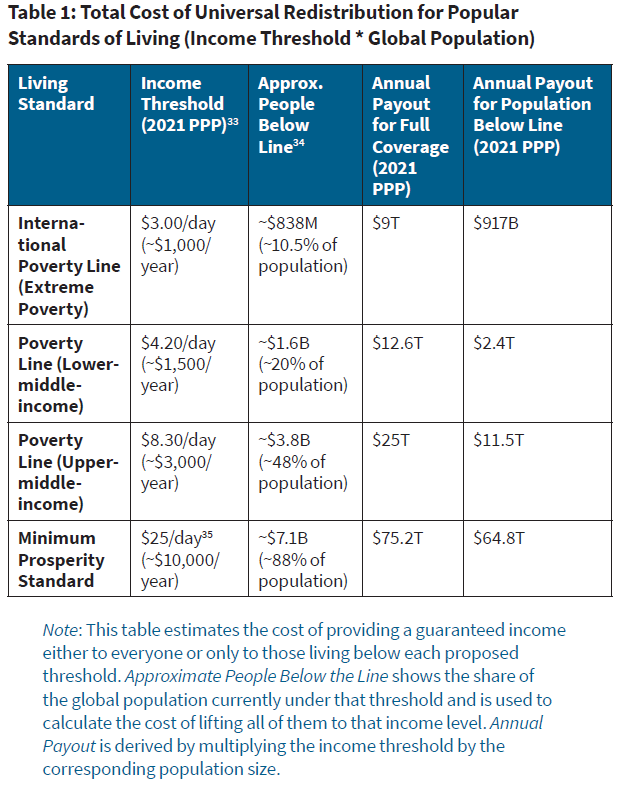
A full analysis would require formal macroeconomic modeling, which lies beyond the scope of this essay. But even rough estimates can illustrate the scale of what’s at stake. Table 1 offers back-of-the-envelope calculations of the annual cost of providing a guaranteed income at various living standards, from the international poverty line to a “minimum prosperity” threshold.
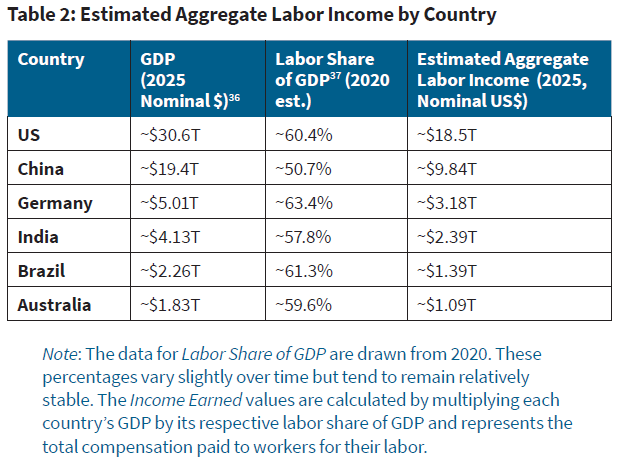
To illustrate the magnitude of payouts relative to existing national incomes they would aim to offset, Table 2 shows the approximate annual labor income, measured in trillions of dollars, for a selection of major economies. Should a substantial portion of the labor share of income shift toward capital, these figures represent the order of magnitude of capital income flows that could accumulate as wealth in the hands of firms and asset owners, wealth that, in principle, could form the basis for future taxation or redistribution.
Two main approaches could be considered for implementation. The first is a pay-as-you-go direct transfer model, in which incoming funds are distributed to recipients as they are received. The second is an investment model, where funds are pooled and invested, and only a portion of the returns is distributed.
A direct transfer model remains vulnerable to shifting political priorities, fiscal crises, or the risk of nations opting out, since it would require raising equivalent funds each year through mechanisms akin to taxation, much like a traditional UBI scheme. By contrast, an endowment-style model anchored in invested capital could be largely self-sustaining, with its principal generating returns independent of annual budget negotiations or political cycles, similar to how sovereign wealth funds operate. While assembling the initial capital base for such a fund would pose a far greater challenge, examining the conditions necessary to establish it offers valuable insight into the feasibility of long-term, globally coordinated financing mechanisms.
“If we are to envision a world in which a majority of people no longer work, then perhaps it is also time to envision a world in which humanity collectively owns a meaningful share of capital. In such a system, income would derive not primarily from wages but from returns on shared ownership of the productive infrastructure that sustains civilization.”
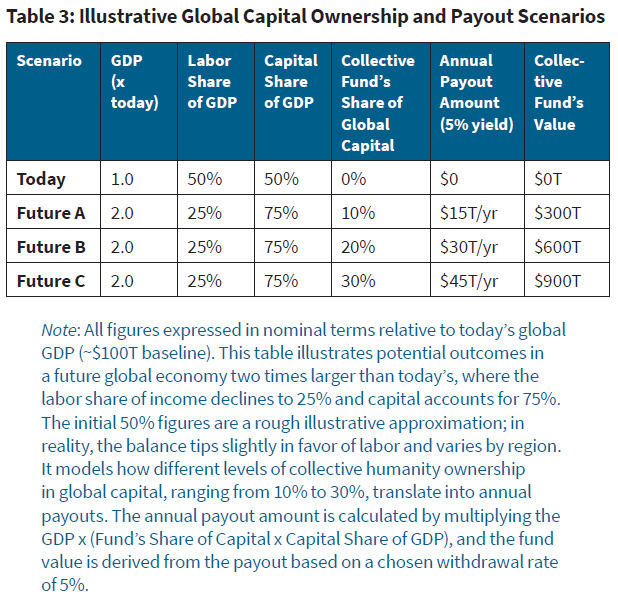
If we are to envision a world in which a majority of people no longer work, then perhaps it is also time to envision a world in which humanity collectively owns a meaningful share of capital. In such a system, income would derive not primarily from wages but from returns on shared ownership of the productive infrastructure that sustains civilization (see Table 3). This collective model could coexist alongside the forms of private ownership that characterize today’s economies, offering a new balance between individual enterprise and shared prosperity.
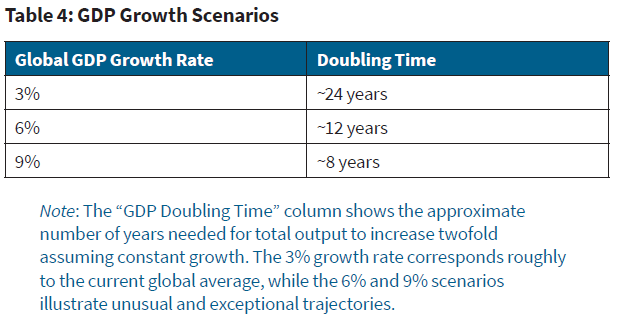
Lastly, if redistribution on this scale depends on a vastly larger world economy, the key question becomes how quickly such growth could occur. Table 4 compares doubling times under current conditions versus accelerated AI-driven growth.
The practical path forward will likely combine an investment-based approach, beginning with an AI stock portfolio, with a direct transfer model derived from philanthropy to prototype and scale the system in its early stages. Economist Anton Korinek has proposed a similar “seed UBI” concept:38 small, early payments that establish the infrastructure for universal income before large-scale funding becomes available.
Starting in the poorest countries would stretch each dollar further, extend benefits to more people, and build administrative capacity where it is most needed. Early experimentation with distribution, identity, and governance systems would allow participation long before sufficient wealth exists for full global coverage, ensuring that no population is left behind as the system develops.
Over time, such a framework could begin to raise the global income floor, ensuring that everyone retains the means to meet basic needs in a world where labor is no longer the primary source of income, while modest early distributions serve as a stabilizing force during the transition.
This proposal is not fit for worlds where GDP doesn’t grow, perhaps in scenarios where loss of income leads to decrease in demand. This proposal is intentionally provocative—serving as an exploration of how our economic system might be overhauled to meet the demands of a new era.
These back-of-the-envelope numbers show what’s required. The next question is where the funds could realistically come from.
Capturing the Windfall: Funding the Global Dividend System
If a global dividend system is to be more than a thought experiment, we have to answer a hard question: Where will the money come from? The previous section explored the potential scale of redistribution and two broad financial paradigms: a pay-as-you-go model, which transfers ongoing revenues into direct transfers, and an endowment model, which builds a capital base whose returns can fund long-term dividends. This section turns to the sources of capital that could sustain either approach, examining how the economic surplus generated by transformative AI might be captured, converted, and redistributed.
The Windfall Clause and legally binding commitments
One early idea that attempted to grapple with this challenge was the Windfall Clause, a report by researchers at the Centre for the Governance of AI. It proposed AI companies voluntarily pre-commit in a legal contract to contribute a share of their profits once they crossed a certain economic threshold—say, 1% of global GDP in profits.39 The concept remains interesting, but the original formulation is likely insufficient for today’s landscape. It faces familiar headwinds: Profits are pliable, easily shifted, hidden, or reinvested. Thresholds can be gamed or endlessly deferred. Reviving or building on the Windfall Clause would require significant redesign: tighter definitions, stronger enforcement, and external levers to reinforce accountability.
“One advantage of the Windfall Clause lies in its conditional nature: It allows society to pre-commit to redistributive action before extreme concentration of wealth occurs.”
At present, the world’s six largest technology companies combined generate barely half a percent of global GDP in revenue, and even the leading AI companies remain far from the thresholds of companies like Microsoft, Google and NVIDIA. Yet one advantage of the Windfall Clause lies in its conditional nature: It allows society to pre-commit to redistributive action before extreme concentration of wealth occurs. If the triggering scenario never materializes, no funds are expended; but if it does, governance mechanisms are already in place. Similar ex ante agreements could be applied more broadly, across countries or sectors, for example, activating new redistribution measures automatically if the global labor share of income were to fall below a defined threshold. Such pre-commitments are far easier to establish in advance than to introduce amid a crisis. They could serve as a backstop for extreme monopoly scenarios, embedding contingency governance into the fabric of future markets.
The Windfall Clause was a proposal tailored to frontier AI companies but they may not be the only entities capturing transformative value. And voluntary profit-sharing alone may not offer the enforceability or durability needed. What follows are several approaches that could be explored in parallel.
Equity stakes
One idea that could be pursued in parallel is to secure equity stakes in the firms or infrastructure providers most likely to benefit from AI-led transformation. Unlike profit-sharing pledges, equity provides a legal claim on future value, and can be harder to evade or obscure. But equity-based models assume early action and leverage: that we know where value will accrue, and that public actors can move before capital lock-in. That window may close quickly, and the value chain could splinter across companies, cloud providers, chipmakers, and downstream companies that are quietly automating labor.
Licensing
Another approach might shift focus to the users of AI systems rather than their producers. Imagine a framework where large companies that automate away significant portions of their workforce are required to pay into a global fund as a condition for continued access to advanced AI imposed by the providers—licensing not just the technology, but the responsibility. But that, too, relies on a fragile foundation: a willingness from AI companies to coordinate, a willingness from firms to comply, and enough shared incentive to keep the system from unraveling the moment it becomes inconvenient.
Taxation
Then there’s the state. Governments could tax AI-driven productivity gains or capital income, channeling a portion of the proceeds into an international fund. Such coordination would be difficult, but incentives may shift as automation accelerates. If AI-induced job losses weaken demand, states may find themselves scrambling to sustain consumption and prevent economic contraction. Under those conditions, redistribution could evolve from a matter of social justice to one of macroeconomic stabilization.
“If AI-induced job losses weaken demand, states may find themselves scrambling to sustain consumption and prevent economic contraction. Under those conditions, redistribution could evolve from a matter of social justice to one of macroeconomic stabilization.”
Practical mechanisms might include multilateral tax treaties such as BEPS 2.0, designed to prevent profit-shifting,40 as well as new forms of automation-linked taxation. For instance, governments could adjust tax rates based on the employment-to-output ratio—imposing higher taxes on firms or sectors that generate large amounts of output with minimal human labor. Such a system would effectively capture a share of the productivity gains from automation and redirect it toward maintaining aggregate demand, helping to stabilize economies as the link between employment and income weakens.
Political will
Even fragile foundations have a way of hardening under pressure. The history of social policy is not a history of foresight: The major welfare systems we rely on today didn’t exist before the Industrial Revolution. They emerged in response to breakdown. As factories replaced farms, as urban poverty swelled and wealth concentrated, societies created public schools, labor laws, pensions, and insurance systems—not because they envisioned them in advance, but because the cost of doing nothing became too high.
The same pattern holds at the global level. In 1944, as World War II neared its end and the Great Depression had shattered confidence in freemarket capitalism, 44 nations gathered in Bretton Woods to design a new economic order. Out of that meeting came the IMF, the World Bank, and a global monetary framework.41 It wasn’t consensus that was the driving force. It was crisis.
If AI drives a similar rupture, then crisis will once again force the question. And when it does, the difference will be whether we have something to reach for: a policy framework, an institutional prototype, a draft on the table. It is a question that deserves far more attention, experimentation, and collective foresight.
Capturing a share of AI-driven economic surplus for public benefit won’t be easy. There are no turnkey solutions, and many mechanisms face serious technical and political challenges. Some of these proposals may sound idealistic, but history reminds us that today’s political stretches can become tomorrow’s economic necessities. In a world where labor becomes less central to value creation and there are simply fewer jobs to go around, the boundary of what’s politically and economically feasible could shift, possibly faster than we expect.
Recognizing the Limits
The global dividend represents one concrete approach to a neglected policy challenge, but no single policy can carry the weight of a future this complex. It can provide crucial economic security, but questions of identity, purpose, and meaning will require parallel cultural, social, and political innovations. Nevertheless, the global dividend offers an essential starting point in protecting the dignity of families and communities during an era when the fundamental structures of income and labor are being redefined.
“Eventually, society will need to confront a deeper question: Do we want to move beyond labor markets as our primary tool for income distribution, or do jobs provide too vital a foundation for meaning and identity?”
Beyond the global dividend proposal, other promising paths merit exploration. Some might advocate for universal basic services provided by nations, perhaps funded through multilateral tax treaties, sovereign ownership of key AI infrastructure, or data compensation systems. Others may champion job-guarantee schemes that would create paid roles in care, education, culture, or community-building instead of redistribution. Eventually, society will need to confront a deeper question: Do we want to move beyond labor markets as our primary tool for income distribution, or do jobs provide too vital a foundation for meaning and identity?42 This proposal sidesteps that philosophical debate, instead offering a concrete mechanism for redistribution that could function regardless of how we ultimately answer it.
None of these interventions will be easy. Getting governments to tax powerful domestic industries is hard. Getting multinational firms to commit to global contributions is more challenging still. Creating new institutions for meaningful work may be the most complex of all. But politics has always been about power, and the exercise of it. If the legitimacy of economic systems begins to fray, perhaps even entrenched interests may discover that redistribution is in their own long-term interest.
“If the legitimacy of economic systems begins to fray, perhaps even entrenched interests may discover that redistribution is in their own long-term interest.”
The model outlined here addresses a specific scenario: one with a great AI windfall, in which the economic gains of advanced AI accrue to a handful of companies and countries. If this future seems undesirable, then we should also start sketching alternatives—designing institutions and incentives that push us toward better alternatives. Many researchers and policymakers are already advocating for stricter antitrust enforcement, or to steer AI development toward tool-like systems43 that augment rather than replace human work.44 This proposal complements those efforts by providing a backstop should they fall short. Together, these approaches form an ecosystem of strategies working toward the same goal: ensuring AI’s benefits reach all of humanity.
This is one proposal, built for one possible future. It isn’t offered as a definitive solution, but as a starting point for debate, refinement, and imagination. Some assumptions behind it may prove incomplete or incorrect; only time will tell. But in an era of deep uncertainty and rapid transformation, putting concrete ideas on the table is a way to clarify thinking, surface disagreements, and inspire alternative approaches.
At its best, this proposal is more than a policy exploration—it’s an invitation to imagine a global economy grounded in solidarity and help catalyze discussion about what kind of futures people actually want, and what institutions will be needed to make them viable.
“At its best, this proposal is more than a policy exploration—it’s an invitation to imagine a global economy grounded in solidarity and help catalyze discussion about what kind of futures people actually want, and what institutions will be needed to make them viable.”
1. Special thanks to Anton Korinek, Robert Ward, Yolanda Lannquist, Brandon Jackson, Deric Cheng, Adrian Brown, Anthony Aquire, the Digitalist Papers team and the all the reviewers who provided feedback.
2. This proposal focuses specifically on transformative artificial intelligence (TAI)—AI systems that precipitate a transition comparable to the Agricultural or Industrial Revolution in their impact on society and the economy. Unlike incremental AI improvements, TAI represents a fundamental reorganization of how economic value is created and distributed.
3. Jim VandeHei and Mike Allen, “Behind the Curtain: A White-Collar Bloodbath,” Axios, May 28, 2025, https://www.axios.com/2025/05/28/ai-jobs-white-collar-unemployment-anthropic.
4. “OpenAI Charter,” OpenAI, accessed September 7, 2025, https://openai.com/charter/.
5. Sholto Douglas and Trenton Bricken, “Is RL + LLMs Enough for AGI?,” interview by Dwarkesh Patel, Dwarkesh Podcast, YouTube, at 1:57:08, May 22, 2025, https://youtu.be/64lXQP6cs5M?t=7028.
6. Ed Newton-Rex, “For Silicon Valley, AI Isn’t Just About Replacing Some Jobs. It’s About Replacing All of Them,” The Guardian, May 12, 2025, https://www.theguardian.com/commentisfree/2025/may/12/for-silicon-valley-ai-isnt-just-about-replacing-some-jobs-its-about-replacing-all-of-them.
7. Goldman Sachs, “AI Investment Forecast to Approach $200 Billion Globally by 2025,” August 1, 2023, https://www.goldmansachs.com/insights/articles/ai-investment-forecast-to-approach-200-billion-globally-by-2025.
8. Eugenio M. Cerutti, Antonio I. Garcia Pascual, Yosuke Kido, Longji Li, Giovanni Melina, Marina Mendes Tavares, and Philippe Wingender, “The Global Impact of AI: Mind the Gap,” Working Paper No. 2025/076 (International Monetary Fund, April 11, 2025), https://www.imf.org/en/Publications/WP/Issues/2025/04/11/The-Global-Impact-of-AI-Mind-the-Gap-566129.
9. David H. Autor, “Why Are There Still So Many Jobs? The History and Future of Workplace Automation,” Journal of Economic Perspectives 29, no. 3 (2015): 3–30, https://doi.org/10.1257/jep.29.3.3.
10. Anton Korinek and Megan Juelfs, “Preparing for the (Non-Existent?) Future of Work,” Working Paper No. 30172 (National Bureau of Economic Research, June 2022), https://www.nber.org/system/files/working_papers/w30172/w30172.pdf.
11. Geoffrey Hinton, quoted in “Godfather of AI Geoffrey Hinton Warns of ‘Massive Unemployment’ and ‘Soaring Profits’ Under Capitalist System,” Fortune, September 6, 2025, https://fortune.com/2025/09/06/godfather-of-ai-geoffrey-hinton-massive-unemployment-soaring-profits-capitalist-system/.
12. Korinek and Juelfs, “Preparing for the (Non-Existent?) Future of Work.”
13. Lukasz A. Drozd and Marina M. Tavares, “Generative AI: A Turning Point for Labor’s Share?,” Economic Insights (Federal Reserve Bank of Philadelphia, 2024 Q1), https://www.philadelphiafed.org/-/media/FRBP/Assets/Economy/Articles/economic-insights/2024/q1/eiq124-generative-ai-a-turning-point-for-labors-share.pdf.
14. Anton Korinek, “Economic Policy Challenges for the Age of AI,” Working Paper No. 32980 (National Bureau of Economic Research, September 2024), https://www.nber.org/system/files/working_papers/w32980/w32980.pdf.
15. Clayton Chancey, “The AI Value Capture Paradox in 2025,” Foray Consulting, February 2025, https://www.foray-consulting.com/thought/ai-value-capture-paradox.
16. Cody Corrall, “Week in Review: OpenAI Could Charge $20K a Month for an AI Agent,” TechCrunch, March 8, 2025, https://techcrunch.com/2025/03/08/week-in-review-openai-could-charge-20k-a-month-for-an-ai-agent/.
17. Cristina Enache, “Sources of Government Revenue in the OECD,” Tax Foundation, May 22, 2025, https://taxfoundation.org/data/all/global/oecd-tax-revenue-bycountry/.
18. Frank Clemente, Hunter Blair, and Nick Trokel, “Corporate Tax Chartbook: How Corporations Rig the Rules to Dodge the Taxes They Owe,” Economic Policy Institute, September 19, 2016, https://www.epi.org/publication/corporate-tax-chartbook-how-corporations-rig-the-rules-to-dodge-the-taxes-they-owe/.
19. Tax Policy Center, “What Are the Sources of Revenue for the Federal Government?,” Tax Policy Briefing Book, updated January 2024, https://taxpolicycenter.org/briefing-book/what-are-sources-revenue-federal-government.
20. Jan Kulveit, Raymond Douglas, Nora Ammann, Deger Turan, David Krueger, and David Duvenaud, “Gradual Disempowerment: Systemic Existential Risks from Incremental AI Development,” Gradual Disempowerment, January 2025, https://gradual-disempowerment.ai/.
21. Dean Yang, “International Migration, Remittances, and Economic Development,” NBER Reporter no. 1 (2025): 21–24, https://www.nber.org/reporter/2025number1/international-migration-remittances-and-economic-development.
22. Andre Barbe and David Riker, “The Effects of Offshoring on U.S. Workers: A Review of the Literature,” Journal of International Commerce and Economics (June 2018), https://www.usitc.gov/publications/332/journals/offshoring_and_labor_final_0.pdf.
23. Astrid Krenz, Klaus Prettner, and Holger Strulik, “Robots, Reshoring, and the Lot of Low-Skilled Workers,” European Economic Review 136 (July 2021): 103744, https://www.sciencedirect.com/science/article/abs/pii/S0014292121000970.
24. Tristan Reed, “Export-Led Industrial Policy for Developing Countries: Is There a Way to Pick Winners?,” Journal of Economic Perspectives 38, no. 4 (Fall 2024): 3–26, https://doi.org/10.1257/jep.38.4.3.
25. Anand S. Rao and Gerard Verweij, “Sizing the Prize: What’s the Real Value of AI for Your Business and How Can You Capitalise?,” PwC, September 2017, https://www.pwc.com/gx/en/issues/analytics/assets/pwc-ai-analysis-sizing-the-prize-report.pdf. The $1.7 trillion figure for the Global South excluding China is calculated based on PwC’s regional breakdown, as discussed in Chinasa T. Okolo, “AI in the Global South: Opportunities and Challenges Towards More Inclusive Governance,” Brookings Institution, November 1, 2023, https://www.brookings.edu/articles/ai-in-the-global-south-opportunities-and-challenges-towards-more-inclusive-governance/.
26. Oliver Scott Goldsmith, “The Alaska Permanent Fund Dividend: A Case Study in the Direct Distribution of Resource Rent,” Institute of Social and Economic Research, University of Alaska, January 2011, https://scholarworks.alaska.edu/handle/11122/4161.
27. Parvati Singh, Ryan Brown, William E. Copeland, E. Jane Costello, and Tim A. Bruckner, “Income Dividends and Subjective Survival in a Cherokee Indian Cohort: A Quasi-Experiment,” Biodemography and Social Biology 65, no. 2 (April–June 2020): 172–187, https://pmc.ncbi.nlm.nih.gov/articles/PMC7250001/.
28. Alexander Abramov, Wladyslaw Jermakowicz, and Julian Pankow, “Voucher Privatization in Russia: First Results and Experiences,” Center for Social and Economic Research, January 1994, https://www.researchgate.net/publication/239950663_Voucher_Privatization_in_Russia_First_results_and_experiences.
29. Sam Altman, “Moore’s Law for Everything,” Sam Altman (blog), March 16, 2021, https://moores.samaltman.com/.
30. Bank for International Settlements, “History—The Foundation of the BIS (1930–39),” About BIS: History, accessed September 10, 2025, https://www.bis.org/about/history_1foundation.htm.
31. Bank for International Settlements, Protocol Regarding the Immunities of the Bank for International Settlements, July 1936, https://www.bis.org/about/protocol-en.pdf.
32. Bank for International Settlements, Constituent Charter and Statutes of the Bank for International Settlements, January 1930, https://www.bis.org/about/charter-en.pdf.
33. World Bank, “Update to the Poverty and Inequality Platform (PIP): What’s New,” Global Poverty Monitoring Technical Note 44, June 2025, https://documents1.worldbank.org/curated/en/099510306052516849/pdf/IDU-eb272b02-ecd1-4633-9e37-9297e20a711c.pdf.
34. World Bank, “Update to the Poverty and Inequality Platform (PIP).”
35. Benoît Decerf, Nishant Yonzan, Seylorm Kwakuvi-Zagbedeh, Maria Eugenia Genoni, and Christoph Lakner, “Global Prosperity Gap: The World Bank’s New Measure for Shared Prosperity,” World Bank Blogs, January 8, 2025, https://blogs.worldbank.org/en/opendata/global-prosperity-gap--the-world-bank-s-newmeasure-for-shared-p.
36. International Monetary Fund, “GDP, Current Prices” IMF Data Mapper, accessed October 1, 2025, https://www.imf.org/external/datamapper/NGDPD@WEO/OEMDC/ADVEC/WEOWORLD/US.
37. Our World in Data, “Labor Share of Gross Domestic Product (GDP), 2020,” Our World in Data Grapher, accessed October 1, 2025, https://ourworldindata.org/grapher/labor-share-of-gdp.
38. Anton Korinek, “Preparing the Workforce for an Uncertain AI Future: Written Statement to the U.S. Senate AI Insight Forum on Workforce.” November 1, 2023, https://www.schumer.senate.gov/imo/media/doc/Korinek_Senate_Statement_11.01.2023.pdf.
39. Cullen O’Keefe, Peter Cihon, Ben Garfinkel, Carrick Flynn, Jade Leung, and Allan Dafoe, “The Windfall Clause: Distributing the Benefits of AI for the Common Good,” Centre for the Governance of AI Research Report, Future of Humanity Institute, University of Oxford, 2020, https://cdn.governance.ai/Windfall-Clause-Report.pdf.
40. Organisation for Economic Co-operation and Development, BEPS Project Explanatory Statement: 2015 Final Reports, OECD/G20 Base Erosion and Profit Shifting Project (OECD Publishing, 2016).
41. World Bank, “Bretton Woods and the Birth of the World Bank,” World Bank History Archive, accessed October 17, 2025, https://www.worldbank.org/en/archive/history/exhibits/Bretton-Woods-and-the-Birth-of-the-World-Bank.
42. Daniel Susskind, “Work and Meaning in the Age of AI,” Brookings Institution Working Paper (January 2023), https://www.brookings.edu/wp-content/uploads/2023/01/Work-and-meaning-in-the-age-of-AI_Final.pdf.
43. Anthony Aguirre, “Keep the Future Human,” March 2025, https://keepthefuturehuman.ai/essay/docs.
44. Erik Brynjolfsson, “The Turing Trap: The Promise & Peril of Human-Like Artificial Intelligence,” Daedalus 151, no. 2 (2022): 272–287, https://doi.org/10.1162/daed_a_01915.
